

A recent survey examining human-dog interactions in Indian cities has garnered considerable media attention. While the intention to inform policy is commendable, the methodological approach employed betrays a fundamental lack of understanding regarding the conduct of rigorous social-ecological research on multispecies coexistence. We identify critical limitations in survey design, sampling methodology, and the analytical framework, which collectively compromise the utility of the findings for evidence-based policymaking. We contextualise these concerns within established principles derived from behavioural ecology, spatial epidemiology, and transdisciplinary urban research, drawing upon longitudinal data from Delhi’s 13-year Urban Long-term Ecological Research program.
THINKPAWS offers a constructive critique: we posit that effective policy necessitates rigorous, transdisciplinary science, not opportunistic sampling. Furthermore, confirmation bias, the propensity to favour information aligning with preexisting beliefs, exacerbates divisions between dog advocates and sceptics, thereby prolonging distress for both species. Our analysis, substantiated by research presented at leading institutions like the Indian Institute of Science, National Centre for Biological Sciences, and Nature Conservation Foundation in Bangalore, as well as the Zoological Society of London, Oxford, Cambridge, East Anglia, and Glasgow Universities, and the Behaviour 2025 International Conference at IISER Kolkata, advocates for conducting stratified surveys based on interaction ecology rather than relying exclusively on demographic data.
We call for collaborative dialogues informed by expert consensus, as delineated in our recent policy framework, to foster sustainable coexistence. We assert that the current “exit-poll” style surveys, which rely on opportunistic sampling and binary “Yes/No” questions, are inadequate for capturing the evolutionary and ecological nuances of human-dog interactions. We demonstrate that the conflict is not merely a clash between “dog lovers” and “dog haters,” but is a structurally inevitable outcome of resource provisioning (specifically, the sharing of waste-filled spaces and direct feeding in urbanised areas between dogs and people) and territorial behaviour. We propose a necessary transition from sentiment-based reporting to movement-based ecological analysis to genuinely comprehend and mitigate conflict.
We attempt to outline the following key aspects here:
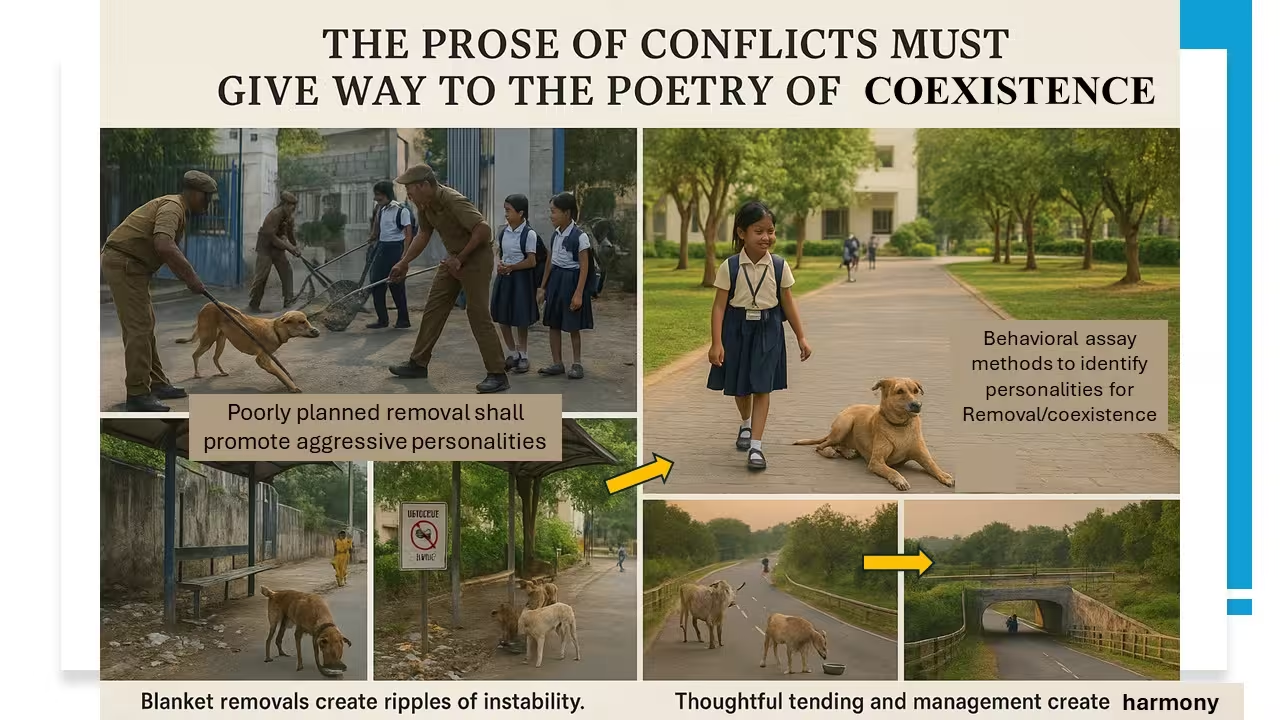
India’s streets host an estimated 60–80 million free-ranging dogs, embodying a unique multispecies urban dynamic shaped by cultural tolerance rooted in Ahimsa (non-violence). This tolerance has enabled remarkable biodiversity persistence across urban-rural gradients despite supporting 1.5 billion people. However, contemporary urbanisation, changing consumption patterns, and infrastructure development are reshaping traditional human-animal relationships in complex ways (Fig. 1). And despite this broad cultural tolerance, Indian attitudes toward animals are not consistent across contexts, considering that people showcase individual variability and versatility based on social parameters: class, caste, gender, age, individual experiences, local ecology, occupation, etc (Check Gupta and Kumar 2025; Ornithological Applications for details).
Against this backdrop, millions of dog bites occur annually in India, with heterogeneous impacts across socioeconomic strata. This genuine public health concern demands scientifically rigorous research to inform balanced policy—not reactionary interventions that could destabilise existing coexistence dynamics while failing to protect vulnerable populations. A September 2025 working paper from Esya Centre, an independent think tank, based on ~1000 interviews across urban India, went viral, claiming 91% Indians feel safer because of street dogs. While timely, the paper’s casual survey approach—relying on ecologically unstratified sampling—misses the ecological intricacies of human-dog interactions.
THINKPAWS, with its Urban Long-Term Ecological Research (ULTER) program, has documented predictable behavioural patterns in dogs attuned to human routines.
This response critiques the paper’s loopholes while proposing science-driven alternatives, ensuring politically sensitive yet evidence-based discourse.
Confirmation bias—the tendency to search for, interpret, and recall information in ways that confirm pre-existing beliefs—poses particular dangers in human-animal conflict research. When researchers approach surveys with predetermined conclusions/respondents who are motivated to respond in a biased way (e.g., would one like to be identified as a dog hater in public?), they risk designing survey tools that validate rather than test hypotheses. This manifests through leading questions, non-representative sampling, and selective interpretation of results. In contexts where dog-phobic and dog-lover communities are already polarised, confirmation bias can transform research into biased advocacy, prolonging both canine and human suffering through ineffective policy prescriptions. In the context of the study, the researchers appear to have fallen prey to this by:
Complex ecological interaction problems should not be simplified to:
Such methodologies resemble exit-poll survey formats, which are fundamentally reductionist when applied to multi-species systems.
The survey’s respondent stratification by conventional demographic variables (age, gender, education, income) fundamentally misunderstands the spatial ecology of human-dog interactions.
Conflict risk is not uniformly distributed across demographic categories but varies systematically with movement patterns and territorial familiarity.
From behavioural ecology, we know that dogs evolved discriminatory capacities to recognise human emotional expressions and respond accordingly. Research from IISER Kolkata demonstrates that dogs distinguish familiar provisioners from unfamiliar transients, exhibiting differential behavioural responses. Shy or non-affiliative dogs remain predictable until cornered by urban infrastructure—roads, walls, crowds—whereupon defensive aggression escalates rapidly.
Dogs have co-evolved with humans for thousands of years, developing a unique capacity to read human emotional expressions and social cues. However, this cognitive ability leads to what we term Categorical Discrimination.
Appropriate Stratification Variables: Rigorous research should stratify respondents by:
Delhi’s 13-year longitudinal research across 32 Urban Long-term Ecological Research sites (n=32, 1 km² each) reveals that people entering unfamiliar dog territories experience significantly higher altercation rates than those with predictable, localised movement patterns. A dog that never troubles local residents may exhibit territorial aggression toward transient visitors—not due to inherent aggression but context-dependent threat perception.
The survey reports that only 30.9% of respondents earned <₹25,000 monthly. This profoundly misrepresents Indian economic reality. According to the State of Inequality in India report, approximately 90% of Indians earn less than ₹25,000 per month—placing anyone earning ₹25k in the top 10% of wage earners. This sampling skew has profound implications: lower-income populations bear disproportionate costs of human-dog conflict. Outdoor workers, waste collectors, and pedestrian commuters—overwhelmingly from economically marginalised communities—experience higher bite risk due to occupational exposure and transportation modes. Meanwhile, the survey’s overrepresentation of higher-income respondents (40.7% earning ₹25,001-₹50,000, 24.8% earning >₹50,000) likely inflates perceptions of dogs as “protective” rather than threatening, reflecting class-based spatial segregation and differential vulnerability. Ethical research on human-animal coexistence must centre on environmental justice concerns, actively oversampling vulnerable populations whose lived experiences diverge dramatically from affluent urban residents.
The survey employs simplistic yes/no questions on complex behavioural phenomena. Binary framings obscure temporal, spatial, and contextual variation. A resident may feel safe from human threats due to territorial dogs, but simultaneously experience anxiety about children playing outdoors. Security guards at Dr. B.R. Ambedkar University reported monkeys selectively targeting them in spatially constrained corridors—contexts invisible to binary safety assessments. Rigorous ethnographic research requires scenario-based questioning that captures complexity:
- “Describe your most recent encounter with a dog outside your immediate neighbourhood”
- “When do you feel dogs in your area are most/least predictable?”
- “How do your movement patterns change due to dog presence?”
Critically, the survey lacks systematic inclusion of documented bite victims and their families—the population most directly experiencing conflict costs. Without comparing perceptions between victims, victim families, general residents, and dog advocates, the research cannot assess how negative encounters shape risk perception and management preferences. Our Delhi research documented a single dog biting >150 people over 3 years in Kirti Nagar, primarily targeting blue-collar workers while being protected by adjacent residents who provided bedding and food but assumed no responsibility for behavioural management. Surveying only the protected residents would yield radically different findings than surveying victimised workers.
Our studies in Delhi since 2019 have frequently documented such problematic individuals throughout the city. This suggests that the potential for constructive human-dog coexistence remains, but it urgently necessitates a scientific approach.
The survey was reportedly conducted in September 2025 with publication by November 2025—a 2-month timeline for surveying 1,063 respondents across 10 cities, data analysis, and manuscript preparation. For context, rigorous doctoral research in social sciences typically requires 3-5 years for sample sizes under 100 respondents to achieve methodological depth. This compressed timeline suggests either: (a) superficial engagement with respondents precluding nuanced understanding, or (b) pre-existing conclusions guiding instrument design and interpretation—both antithetical to scientific inquiry.
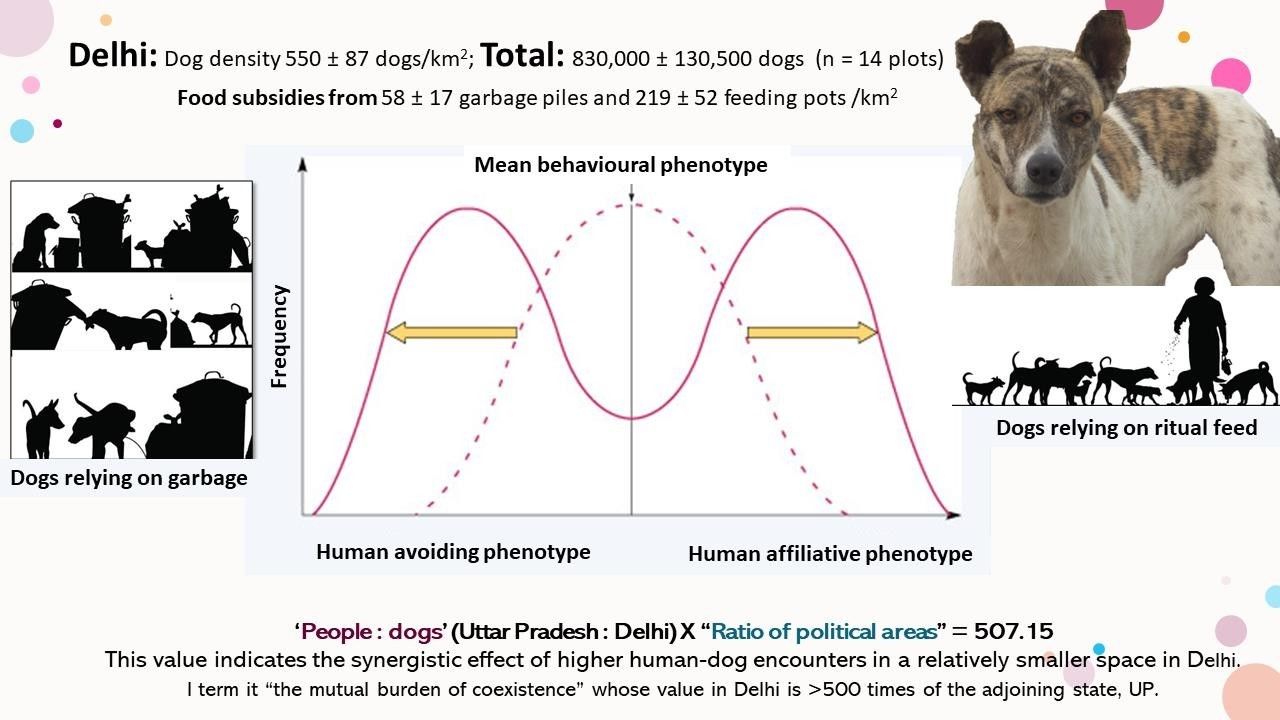
Free-ranging dogs are not static populations but dynamic actors continuously negotiating behavioural ecology in response to feeding rituals, waste dispersion, human/vehicle movement patterns, and architectural constraints. Research from Thinkpaws’ 32-site Delhi network reveals that dogs calibrate behavioural displays—from positive to negative to neutral—to match what ensures meals across different times of day. This behavioural plasticity means dogs in feeding-provisioned, low-traffic zones exhibit heightened territorial aggression toward strangers, while dogs in high-traffic areas remain inactive, sheltering beneath vehicles until off-peak hours (11pm-7am). The “dog problem” is not a fixed population attribute but an emergent property of human-dog-infrastructure interactions (Fig. 1).
Delhi harbours an estimated 795,313 free-ranging dogs at 530±89 dogs/km², supported by 327,069 feeding stations and 85,109 garbage points—infrastructure with a combined carrying capacity approaching 1.6 million dogs. Pack density correlates strongly with feeding infrastructure (r=0.856, p<0.001; n =14) rather than incidental waste; the latter explains the overall density variation across the city. Collectively, this suggests that persistent deficiencies in waste management practices form the foundation for dense human-commensal coexistence. Furthermore, ritual feeding tends to reinforce this social structure, enabling the maintenance of smaller dog packs in proximity to feeding locations. Critically, wealthier neighbourhoods concentrate feeding infrastructure while minimising garbage, whereas lower-income areas exhibit inverse patterns. This spatial heterogeneity means marginalised communities bear disproportionate conflict costs while possessing minimal political agency to shape management interventions—an environmental justice crisis absent from binary safety assessments.
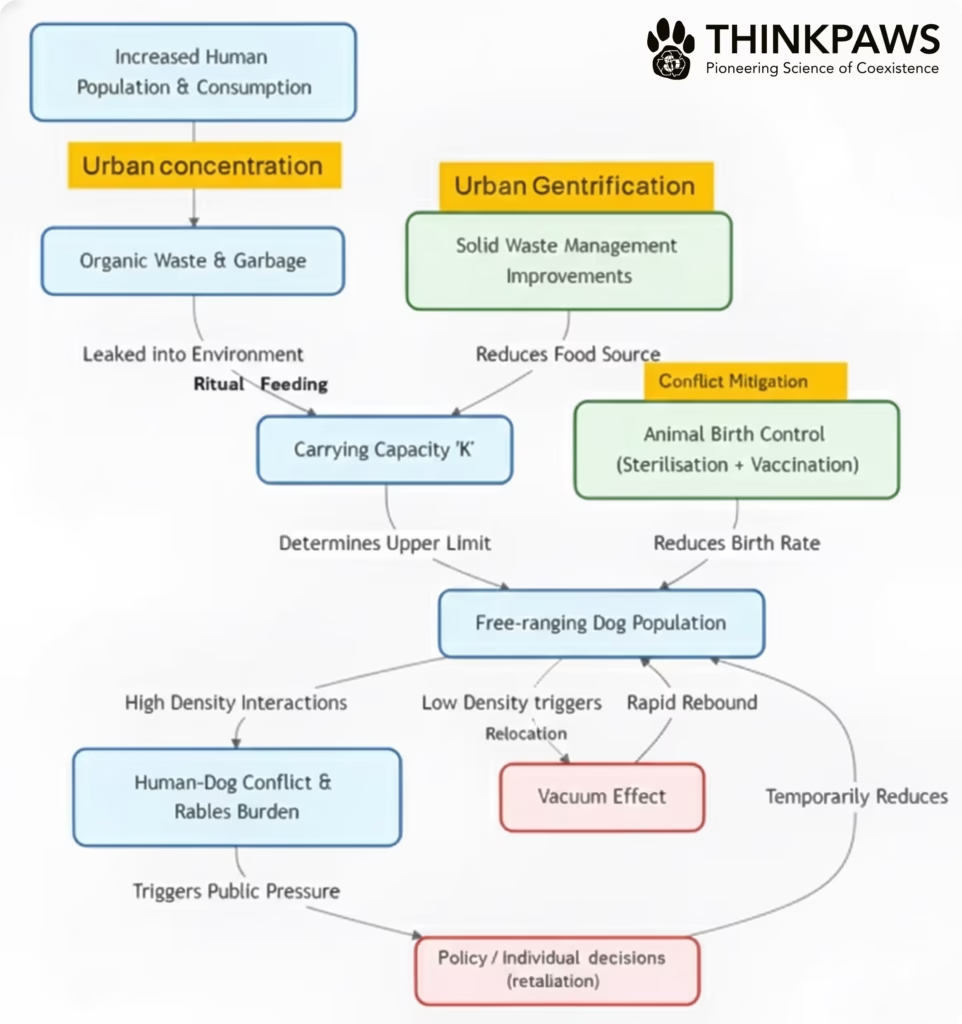
The proliferation of free-ranging dog populations in the urban centres of the Global South represents a complex intersection of socio-economic development, urban metabolic inefficiency, and population/behavioural ecology. While often treated as a discrete animal control issue, the phenomenon is more accurately understood as a systemic symptom of rapid urbanisation where the management of anthropogenic biomass—specifically organic solid waste—has failed to keep pace with economic growth. This Causal Loop Diagram illustrates the structural drivers behind urban stray dog populations. The central spine (in blue) depicts the Metabolic Flow: rapid Urban Concentration and increased consumption generate excess Organic Waste. This “leaked” waste artificially elevates the environmental Carrying Capacity (K), which acts as the primary regulator for the free-ranging Dog Population density. These schematic contrast reactive interventions with structural solutions: (1) The “Vacuum Effect” (Red Loop): This represents the “Fix that Fails” archetype. Retaliatory policies (culling/relocation) trigger a biological feedback loop where the sudden drop in population is rapidly negated by migration and compensatory breeding, as the underlying food resources remain unchanged. (2) High-Leverage Interventions (Green Boxes): Sustainable population control is achieved by targeting the system’s inputs: Solid Waste Management reduces the Carrying Capacity (limiting the intrinsic growth rate), while Animal Birth Control reduces the recruitment rate.
Macaque translocation at Dr. B.R. Ambedkar University achieved full numerical recovery within one month despite 31% removal, demonstrating that displacement fails when underlying attractants—feeding, architecture—remain unchanged. Similarly, a long history of dog culling in a few places in India, Pakistan, etc., has never reduced populations sustainably because territorial vacuums attract immigrants from surrounding saturated areas. Effective management requires modifying human practices—feeding systems, waste infrastructure, architectural design—rather than controlling animal populations directly, en masse.
Transdisciplinary research on human-animal coexistence must:
Complex multispecies coexistence challenges require multidisciplinary expert panels:
Policy dialogues must synthesise diverse expertise—not amplify polarised advocacy from dog-phobic or dog-lover extremes.
The human-dog coexistence challenge in India demands less reactionary sentiment and more rigorous science. While recent survey efforts reflect genuine concern for public well-being, their methodological limitations undermine policy utility. We do not advocate for the vilification of dogs, nor do we support the denial of the problem. As Thinkpaws’ research has shown, dogs are intelligent, adaptable survivors carrying an evolutionary legacy that demands respect, not just affection. Respecting them means understanding their biology—their need to defend territory and resources. Both extremes are wrong: The dog-phobic position that all dogs are problems requiring urgent removal ignores cultural, ecological, and welfare complexities. The dog-lover position that humans are 100% to blame absolves practitioners of responsibility for managing provisioned populations. The path forward requires credible transdisciplinary expertise examining these situations through spatial ecology, behavioural science, public health, and environmental justice lenses. Only by honouring this complexity—rather than validating predetermined conclusions through flawed surveys—can India develop coexistence frameworks that protect vulnerable humans while respecting the remarkable biodiversity tolerance that distinguishes South Asian urbanism.
Leading India’s transdisciplinary research on urban human-animal coexistence
13-year longitudinal research across 32 Delhi ULTER sites