Social media is buzzing with claims that “there are no official records” of Delhi’s dog population. Courts are making decisions in a data vacuum. Critics are demanding evidence-based policy.
In 2023, Thinkpaws team executed a scientific assessment of dog density across Delhi.
Not guesstimates: actual field research at 14 strategically selected sampling locations that are part of Thinkpaws study system: 32 plots across the city monitored since 2012!
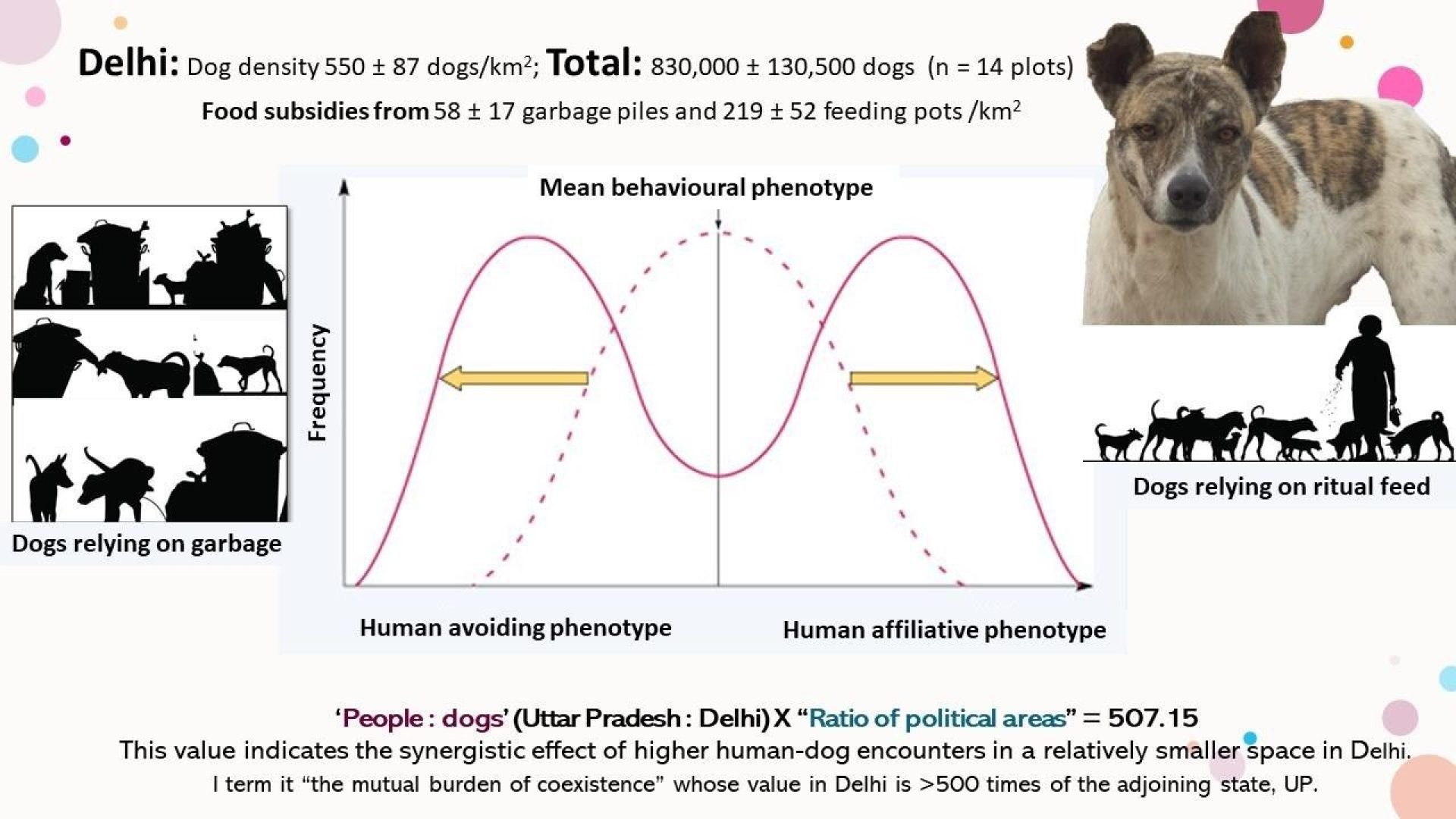
The Numbers Don’t Lie: Our systematic survey revealed a dog density of 550±87 dogs/km². We censused 1,484 individual dogs across 14 sampling units.
When extrapolated across Delhi’s 1,500 km², this yields 825,313 street dogs (range: 694,568 to 956,059). The Supreme Court’s shelter directive suddenly looks mathematically impossible.
The Provisioning-Population Link
We mapped every garbage point, every feeding location, every resource hotspot. Each 1 km² provides dogs with 58±17 garbage piles and 219±52 feeding trays/platforms. The dog numbers therefore are not rocket science, it’s basic ecology expressed by dispersion of human food subsidies along the urban maze.
What We Found?
1. Dogs organize in packs of 5±1 individuals (108±13 packs/km²)
2. Male-to-female ratio: 1.06±0.06 (slightly more males)
3. Each feeding tray supports approximately 2 dogs (328,676 feeding points citywide)
4. Each garbage point supports ~9 dogs (87,787 garbage points citywide)
5. One garbage point = resource value of 4 feeding platforms
The Policy Blindness
Decision makers are implementing solutions without understanding the spatial distribution, behavioral patterns, or ecological drivers we documented. They’re operating on assumptions, not data.
The Uncomfortable Truth: Our research proves what urban ecologists have known for decades—you can’t solve complex coexistence problems without understanding the underlying systems. Every dog “hotspot” we identified correlates with specific human activities, infrastructure gaps, and resource management failures.
Why This Matters
The Supreme Court’s 8-week deadline for mass relocation ignores these fundamental ecological relationships. Moving XX dogs from high-density zones without addressing the provisioning patterns that created those populations? The areas will repopulate within months.
The Solution
Evidence-based interventions targeting the key factors our data identified. Not reactive policies based on public pressure and judicial frustration. 3-5 years of fieldwork. Peer-reviewed methodology. Reproducible results.
The data everyone is looking for exists. At Thinkpaws, we could foresee the need and did the heavylifting years in advance.
The question is: Will policymakers finally use it and will we have space of crucial science of coexistence?
Because making decisions without data isn’t governance. It’s gambling with public health and animal welfare.
Take a deeper dive into the science – Read More Here.