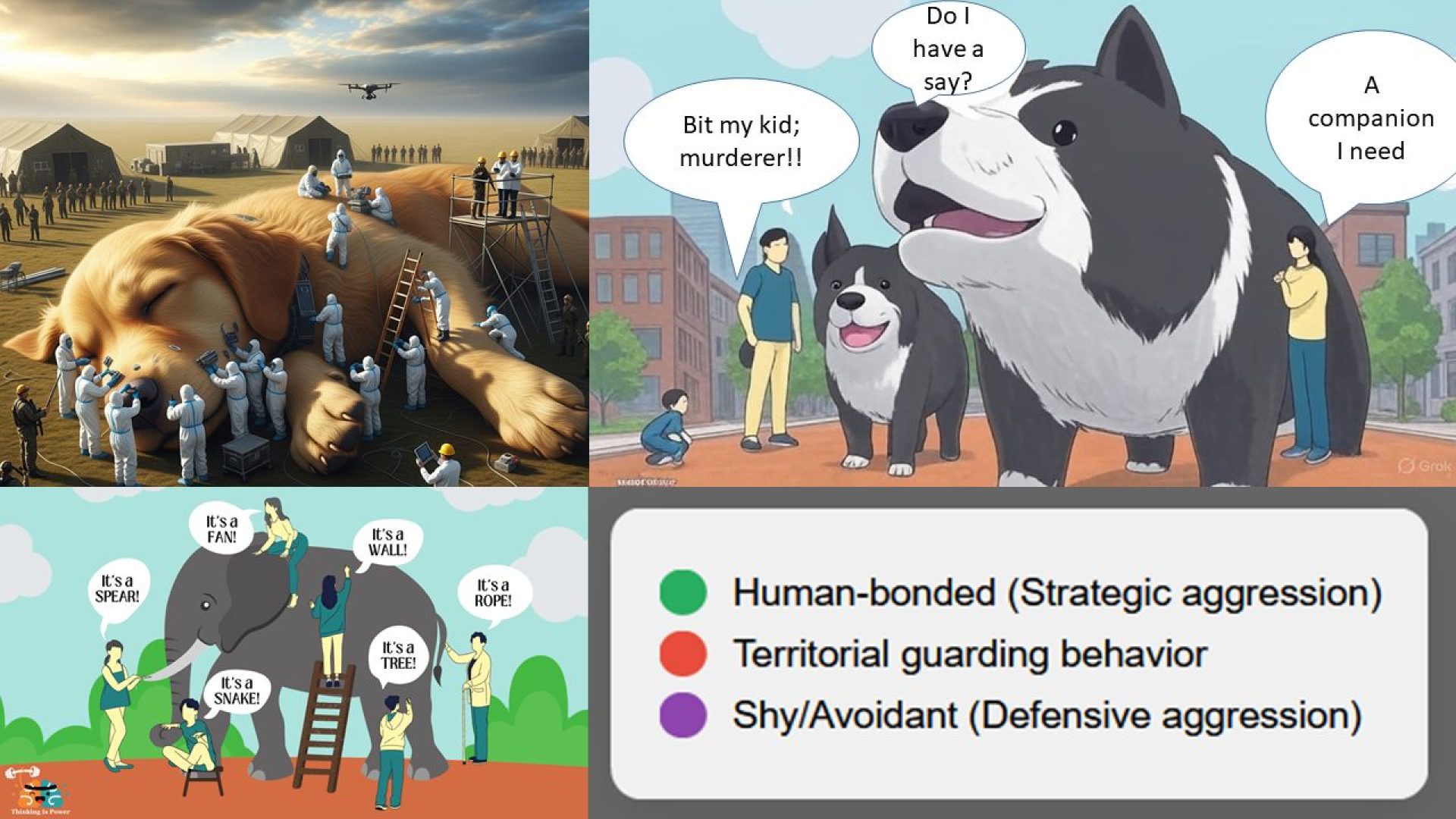
The internet is buzzing with right vs. wrong arguments about street dogs, but we’re missing actionable solutions. Like 04 blind Indian scholars’ parable examining an elephant, each group sees only part of the problem. Here’s how different stakeholders can contribute meaningfully:
Dog Lovers (The Largest Human Community)
Yes, you’re the majority—otherwise dogs would’ve been removed from our systems long ago. But casual feeding on roads is a major disregard and carelessness masquerading as love. Feeding patterns directly shape dog behavior. Your kindness creates mutualistic relationships (tail wagging, affection), but the same dogs stay and suffer on roads, may bark, chase, or bite unfamiliar people. This categorical discrimination between familiar/unfamiliar humans taps into dogs’ ancient domestication traits.
Action: Dogs DO NOT require FEEDING but areas where they find refuge in association with scavenging opportunities; they should have the option to avoid humans unlike what is offered in built environments in Delhi. You must take responsibilities like vaccination and care with awareness that any form of resource provisioning influences behavioral repertoires and territorial responses.
People Who Fear Dogs
Your concerns are 100% valid, often rooted in personal or family experiences. While magical interventions to remove all street dogs aren’t feasible and could worsen conflicts, you can help identify problematic individual dogs.
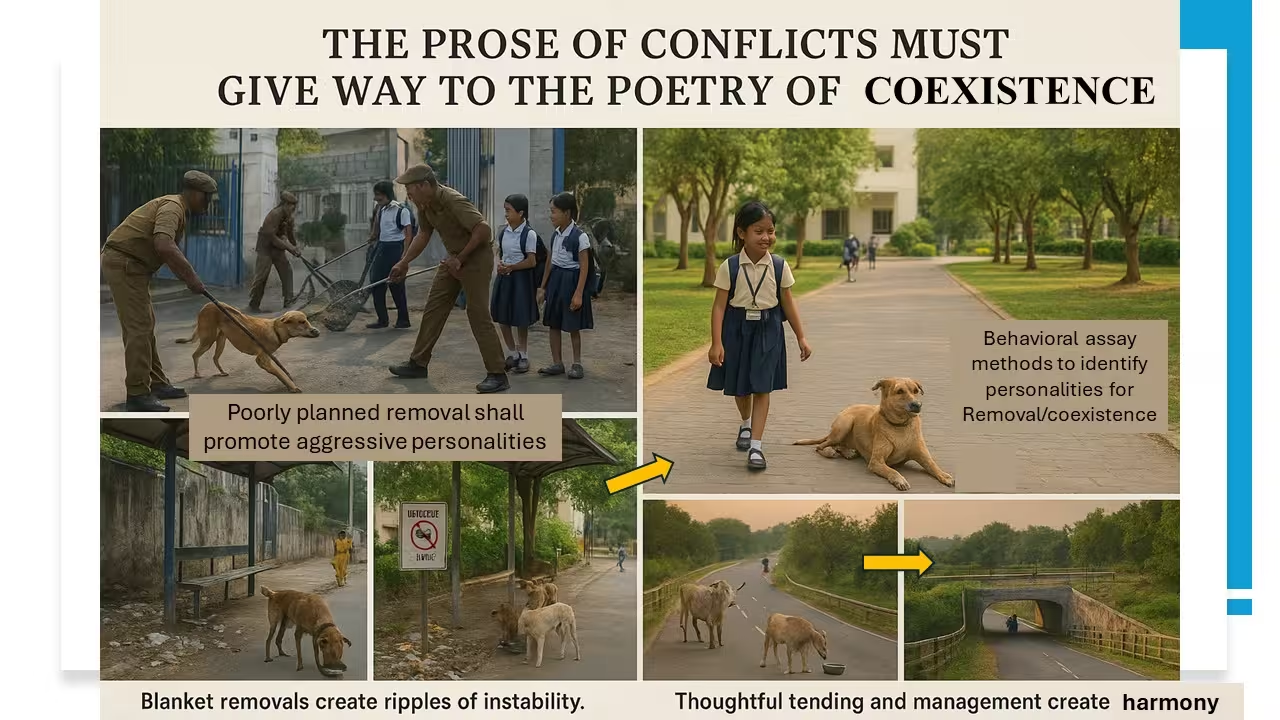
Action: Work within the social-ecological fabric to report genuinely dangerous or diseased dogs for targeted intervention, rather than advocating blanket removal.
Professionals: Waste Management, Animal Experts, Biologists
Modern infrastructure is reshaping dog population & behavioral ecology in unprecedented ways. Road configurations now mediate food dispersion, altering pack social structures—a new evolutionary stressor. We need research on how dogs as vectors affect rabies and zoonotic disease persistence.
Action: Collaborate on studying infrastructure’s impact on dog behavior and disease transmission/persistence patterns in tropical cities.
Religious Leaders & Mass Feeding Operations
Food input into dog social systems creates more dogs. Population booms in recent decades are a function of large-scale feeding practices. Dogs evolved eating scraps, not abundant provisioned meals.
Action: Recognize that mass feeding programs, while well-intentioned, can destabilize human-dog coexistence through uncontrolled population growth, spiraling into conflicts.
The path forward isn’t choosing sides. It’s leveraging each group’s unique position to address specific aspects of this complex urban ecology challenge. Data-driven, stakeholder-specific actions beat endless debates.
For those who want a deeper dive into the science – Read More Here.