Co-Founder & Chief Scientist, Thinkpaws Sustainability Research Foundation
DBT/Wellcome Trust UK India Alliance Fellow (National Centre for Biological Sciences, TIFR & University of Oxford)
The Supreme Court just ordered something that will make the dog problem exponentially worse.
The Affiliation Trap We Created
Here’s what policy makers don’t get: dogs that bond with humans aren’t automatically “safer.” They’re strategically aggressive in completely different ways. These human-bonded dogs have cracked the code. They’ve learned that specific behaviors—tail wagging, approaching feeders, displaying loyalty—guarantee food rewards from our religious and cultural feeding rituals. But here’s the kicker: their guarding behavior, the very barking and territorial defense that makes us feel “protected” on our streets, comes with the same package.
We LOVE this arrangement. Dogs guard “our” streets, chase away strangers, bark at unfamiliar faces. We feed them as “reward”. But we’re horrified when this same territorial aggression targets the wrong people.
The shy, non-affiliative dogs? They’re actually more predictable—they come into conflict when cornerned or when someone tries to forcibly come close, much like human introverts who become uncomfortable entirely.
The Disease Multiplication Effect
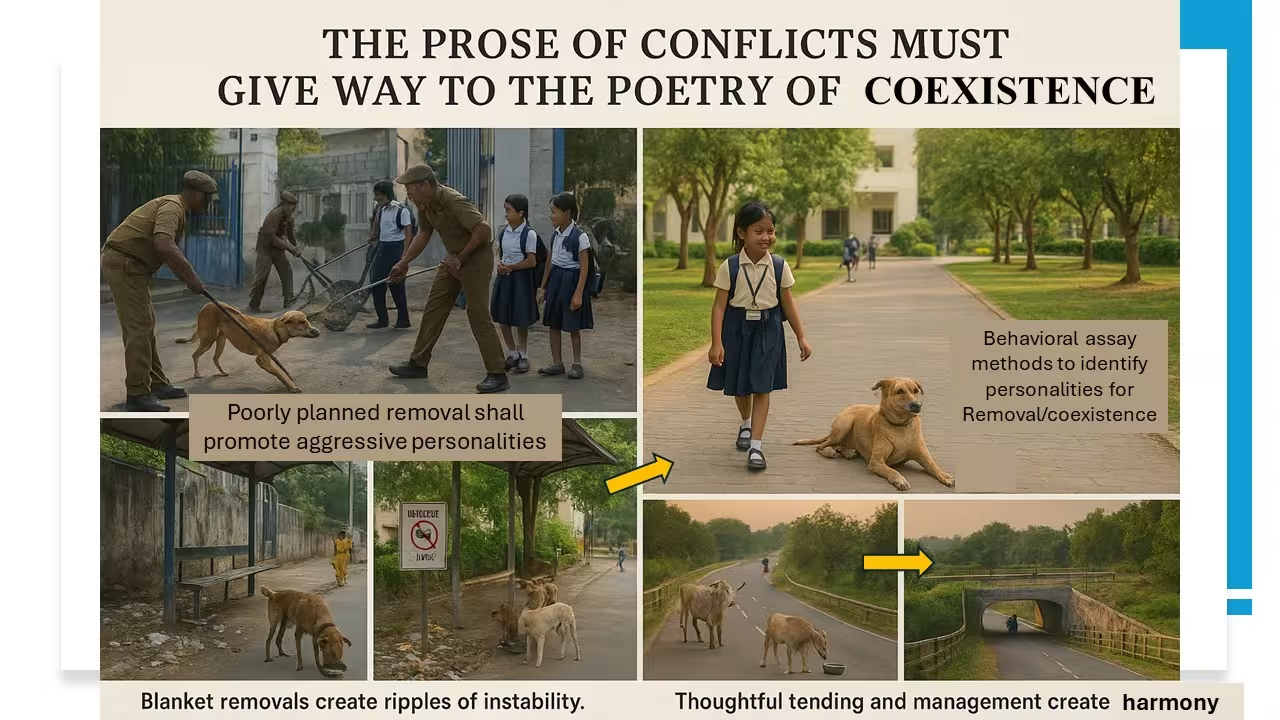
Published research shows removing dogs INCREASES rabies transmission. When you empty territories, infected dogs scatter wider, carrying disease to previously clean zones. With India’s 100 million strays, even removing Delhi NCR’s millions creates territorial chaos that accelerates disease spread to humans, livestock, and wildlife.
Pack Dynamics 101
You Can’t Catch Them All!!! Breaking up established pack hierarchies without removing entire groups triggers behavioral pandemonium. Remaining dogs become unpredictable wildcards. Social structures collapse. Aggression patterns go haywire.
The Real Irony?
We domesticated dogs on these very rural streets over millennia. Tigers use human forest paths. Elephants follow our trails. Coevolution isn’t a bug—it’s a feature whose modern benchmarks need serious examination.
Bottom Line? Mass removal creates the exact conditions that make dogs more dangerous, diseases more widespread, and conflicts more intense. Science predicted this outcome decades ago.
For those who want a deeper dive into the science – Read More Here.